Alex Maskara
Thoughts, Stories, Imagination of Filipino American Alex Maskara
Welcome
HOME
On Sacred Ground
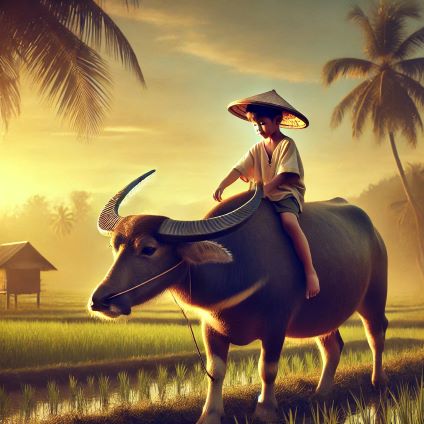
I think I understand now why I had to go through what I went through. The thought came to me this morning while I was walking through the barrio, when the day had barely begun and the road still belonged mostly to early risers like me—the old men sweeping their yards, women already preparing breakfast, and the occasional tricycle sputtering past and disturbing the silence. Somewhere behind a concrete wall, a rooster announced himself with ridiculous confidence, and another answered from farther away. Dogs barked at nothing, or perhaps at me, although after seeing me pass several times these past few days, they seem to have decided that I belong here.
This is the same town I knew long ago, and yet it isn't. Houses have risen where there used to be open spaces. Concrete walls have replaced old fences. Stores occupy corners I remember differently. Motorcycles suddenly emerge from narrow streets that, in my memory, were hardly streets at all. Still, underneath everything new, there is something stubbornly familiar—the dampness of the morning air, the smell of breakfast drifting from somebody's kitchen, the sound of voices carrying easily from one house to another. I have been away too long. Or perhaps just long enough.
All the stress, distractions, and excitement of these past weeks temporarily pulled me away from myself. They did not destroy my old routines, but they certainly disrupted them. For a while, I stopped doing what I normally do. I became busy simply because there were so many things to be busy about. But not for long. One thought keeps returning to me: keep your feet planted on the solid and sacred ground of the Lord.
Maybe that is what this walk is about. Maybe that is what coming home is about.
There is a reason the Lord brought me back here. At first, I thought the explanation was obvious: loss, death, loneliness, and the sudden disappearance of the people who had made my American life feel secure. But perhaps those were only the events that pushed the door open. The deeper reason may have very little to do with tragedy. After all, what am I supposed to do here that I wasn't already doing in Florida? Meditate, exercise, read, write, talk about health and plants, garden, observe people, collect stories, conjure up stories when real life doesn't provide enough of them, take care of myself, and seek God in silence. The work remains the same. Only the ground beneath my feet has changed.
As I walked, I passed a small store and heard people talking inside. Someone recognized me, and there came the usual greeting and questions. Where have I been? Am I staying for good? How is America? I answered politely, exchanged a few words, smiled, and continued walking. During my first few days here, I loved these conversations. I had been gone for decades, after all. Everything fascinated me. The food fascinated me. The old people fascinated me. The changed streets fascinated me. I wanted to see places I hadn't seen forever. I wanted to taste this and buy that. I went on a small splurge—furniture, kitchenware, clothes for everyday use, shoes, and household things I didn't know I needed until I saw them.
It was fun for a while, until my body said otherwise. Fatigue arrived first, followed by poor sleep, allergies, sinus trouble, urticaria, and what felt like the beginning of a cold. My body, apparently, had not received the announcement that I was supposed to be having the time of my life. I laughed at that thought as I continued toward the market.
"Hold it."
That was what the Holy Spirit seemed to be telling me. Hold it. What are you doing? Stick to your guns.
I had allowed myself to become misdirected, perhaps by ordinary human excitement and curiosity, perhaps, as I understand it spiritually, by those forces that are always ready to pull us away from the path when we become distracted. But the Holy Spirit kept calling me back. I had known peace before. In Florida, despite everything, I had developed a routine. There was continuity to my days. I knew when to meditate, when to walk, when to work in the garden, when to read, and when to sit at the computer and write. I knew the stores. I knew the parks. I knew my house.
And Jim was there.
Even when we weren't talking, his presence mattered. He could be in another room while I was doing my own thing, and somehow that was enough. There was another human being in the house. If something went wrong, somebody was there. Then suddenly he wasn't. The crutch was snatched away, and although I had always considered myself independent, I suddenly became aware of the fragility underneath all that confidence.
I had spent years taking care of myself and, professionally, taking care of others. I knew how to manage a household. I knew how to solve problems. I knew how to live alone. Or so I thought. When Jim died, I suddenly became aware that there I was in Florida, in a house I had worked hard to maintain, surrounded by all the familiar structures of my American life, yet the ground beneath me no longer felt solid. Who would I call? Who would know if something happened? Who would even notice? My brother-in-law was there, yes, but that everyday sense of security was gone.
Perhaps that was when the road beneath my feet began turning toward this road—the very road I was walking this morning. Toward home. Toward the house my parents built. Toward the country where I was born. Toward these roosters that still refuse to stop crowing. I smiled when I thought about that.
The Lord worked things out, although not instantly and certainly not without confusion. I still had the house in Florida to sell. I had belongings to dispose of, arrangements to make, finances to untangle, and then there was the problem created by my tenant, another complication arriving exactly when I did not need one. But one by one, things began moving. The rental came in. The State Farm refund arrived. Then came the email from the mortgage company regarding the payout. Closing is getting closer. So far, so good.
Why am I worrying?
That question followed me as I walked. Why am I borrowing trouble from tomorrow when today's road is right here beneath my feet?
I reached the market and bought what I needed. Nothing dramatic, just food for the day and perhaps another household item I suddenly remembered I didn't have. A garbage can. A dustpan. Something for the kitchen. These necessities reveal themselves gradually. You don't realize you need something until you reach for it and discover it isn't there. That, too, is part of settling down.
I have also discovered that many of the things I need can be ordered online. Plants, household supplies, even products for my allergies that don't require a prescription. Packages arrive, boxes are opened, and another small piece of my new life takes its place inside the old house. And then there are the plants, of course. They are beginning to arrive too, and that excites me in a different way because gardening is not a distraction. Gardening belongs to the life I already know.
I imagine the spaces around this house becoming greener. I think about the garden I left in Florida and how much time I spent alone among the plants, touching soil, trimming leaves, observing what survived and what didn't. I can do that here, perhaps even more than I did there.
On the way home, I passed people again—familiar faces, vaguely familiar faces, and faces belonging to people I probably knew forty or fifty years ago but can no longer place. Everyone looks strangely familiar here. That is one of the oddest things about returning to the Philippines after living so long in America. In the United States, I became accustomed to variety—faces from everywhere, accents from everywhere, different colors, heights, shapes, styles, and temperaments. Beauty and ugliness mixed together in endless combinations. I miss that variety. I also miss the cleanliness and order of certain places, the carefully designed parks, and those wide spaces where I could walk for miles without needing to speak to anyone.
Here, everyone somehow looks like somebody I might be related to. Perhaps that is why the novelty wears off quickly. I enjoy talking to people I knew before. I enjoy hearing what happened to them, who married whom, who left, who returned, who died, and who built the new house on the corner. But after a while, small talk exhausts me. I begin looking for an exit. "Well, nice seeing you. Take care. See you around." Then I walk away, relieved to be alone again.
I am beginning to realize that there is nothing wrong with that. I don't have to perform for the barrio. That may be one of the most important lessons of coming home. Nobody is watching me as closely as I imagine, and even if they are, why should it matter? I do not need to become "the returning American." I don't need to be the cool guy from the States. I don't need to impress anybody with where I've been, what I've done, what I own, what I know, or how long I lived abroad. I don't need to become popular, admired, respected, or even particularly interesting. None of those things mattered much to me in America, so why should they matter here?
My life has already become quieter than that.
As I turned onto the road leading back toward the house, the morning had become brighter. More motorcycles passed. A tricycle rattled by. Somebody was sweeping leaves into a pile. Cooking smells drifted into the street. A radio played somewhere behind an open window. The barrio had awakened, and strangely, as everything around me became noisier, I felt quieter inside.
This is what I need: return to the program. Meditate. Read. Write. Exercise. Attend to the plants. Maintain the house. Eat properly. Watch my sugar, blood pressure, and cholesterol. Rest. Avoid unnecessary stress. And perhaps most important, stop trying to please everyone I encounter.
There is tremendous freedom in anonymity, silence, and not needing to explain myself. I can walk to the market in the morning, buy what I need, return home, close the door, and enter the room that changes according to the hour. Sometimes it is a bedroom. Sometimes it is a reading room. Sometimes it becomes my office. Sometimes it is simply a place of prayer. And there I write.
Writing is the constant. It fixes my life in space and time. Without it, days can dissolve into one another. Experiences become impressions, impressions become fragments, and eventually fragments disappear. But when I write them down, I can examine them. I can separate what matters from what is useless, what is nourishing from what is wasteful, and what belongs to my path from what merely distracts me.
Perhaps that is why I was brought back here—not to begin another life exactly, but to continue the one I had already begun. Florida taught me solitude. It taught me routines. It taught me how to create a private world of books, exercise, gardening, meditation, and writing. America gave me decades of work and experience, but retirement seems to be asking something different of me now: be still enough to understand what all those years were for.
So I walk. Every other morning, if my body permits, I walk these barrio streets. I watch them awaken. I listen to the dogs, roosters, motorcycles, radios, and conversations spilling out of houses. I pass old homes and new ones, people I remember and people who seem to remember me better than I remember them. With every walk, the place becomes a little less strange. The house becomes more mine. The silence becomes familiar. My old routines return.
At five in the morning, I meditate again. I read again. I write again. I tend to the plants. My allergies still bother me now and then, and there are still problems waiting to be resolved. The Florida house has not completely disappeared from my responsibilities, and there will undoubtedly be other complications. Life does not suddenly become perfect simply because one crosses an ocean. But the anxiety is beginning to dissipate because I am beginning to understand that I don't have to solve my entire future today.
I only have to follow what has been apportioned to me: one morning, one walk, one meal, one plant, one book, one page, one prayer at a time.
When I reached the gate of my parents' house this morning, I stopped for a moment before going inside. For decades, I thought of this place as the home I had left behind. Now it is simply home again. Perhaps the Lord did not bring me back here to make me more involved with the world but to give me enough distance from it—to remove some of the burdens that had accumulated around my life: the mortgage, utilities, insurance, taxes, maintenance, and the constant calculations required to keep a house running while growing older alone. Those things consumed more of me than I realized.
Now the assignment seems simpler. Take care of what has been given to me. Take care of my body. Take care of this house. Take care of the plants. Read the books. Write the stories. Record the meditations. Walk while I still can. Observe. Listen. Pray. And stop worrying so much about who might be watching.
I opened the gate. Behind me, the barrio continued with its morning—roosters, dogs, voices, engines, brooms scratching against concrete, pots clattering in kitchens. Ordinary sounds from an ordinary town I once left behind in search of another life. I have returned after all these years, older and carrying an entire American lifetime inside me.
But perhaps I did not return here to recover the boy who once left this barrio.
I returned as the man all those years created.
And now, on this old ground, I can continue the work. Stick to your guns, I reminded myself as I walked inside. Keep your feet planted.
The ground beneath them is sacred enough.
2026-09-15 22:23:36
blog
GRIEF: Learning to Live With Jim’s Absence
Visions of St Lazarus Chapter 7
Reflection on Being Alone with a Purpose
Contemplation of an Ordinary Man
American Son by Brian Ascalon Roley
Linda Ty-Casper: Awaiting Trespass
Personal Thoughts while Sampling the poetry of Nick Carbo
Naomi: Reflection on Holy Week
Visions of St Lazarus : Expanded version of Lazarus Kafkaesque Paper
Ramon Santos Reflections While Recovering
The Mild Stroke of Ramon Santos
Popong 22: Meditation On Handling Temptations
Popong 21 - Friday Night Reflection
Popong 19/ Life is Learning and Exploring
Popong 18 / Avoiding Distraction
Popong 12 / Meditation on Computer Obsession
Sunday Thoughts and Book Review
A Night at the Luneta Grandstand
Understanding my unique Self on my way to Retirement
A Visit to Quiapo with El Fili2
THE DIARY OF ANTONIO PIGAFETTA
Brother, My Brother (Ben Santos)