Alex Maskara
Thoughts, Stories, Imagination of Filipino American Alex Maskara
Welcome
HOME
Four Students 8
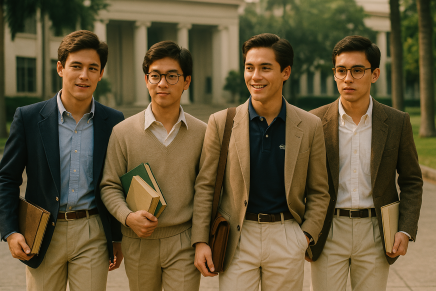
RENE
Rene chose to major in Economics, with a minor in Political Science, because of his hunger for power, politics, and money. Who in Maliwalu didn’t dream of those things? The best way to learn the tricks of the trade, he believed, was through higher education—specifically at Maliwalu State University, the country’s most prestigious institution.
State U didn’t just teach theory. It embodied the reality of social stratification. Maliwalu itself was a perfect example of what people often described in discussions about developing nations: a rigid divide between the poor, the middle class, and the elite. There were the educated and the illiterate, the proletariat and the bourgeoisie—each group existing in its own world, yet constantly aware of the others.
To borrow a line from Dickens, it was the best of times and the worst of times. Maliwalu was both Paris and London—alive with all kinds of people and social classes. But unlike those cities, it lacked a culture of independent thinking. Instead, its citizens prided themselves on imitation. They tried hard—sometimes too hard—to look, speak, and behave like New Yorkers, Londoners, or Parisians.
For Maliwalans, visiting the Eiffel Tower or London Bridge was a badge of status. Meanwhile, foreigners who came to Maliwalu were often seen as either criminals escaping justice, missionaries tending to the poor—or worse. Still, many locals didn’t mind. As one student casually put it, “Let them take care of our poor. I’m leaving for New York after graduation anyway. Better to be a New Yorker than a Maliwalan.”
This was the essence of class in Maliwalu. While the urban poor rallied for better housing in Tokando, the wealthy expanded their mansions in Follows Park. The middle class lived paycheck to paycheck, stuck in place. The poor got poorer, the rich got richer, and the middle class remained trapped in between.
“We’re living in a capitalist society,” professors would remind their sociology students. “Inequality is expected. What matters is economic growth.”
But the benefits of that growth never reached the poor. International observers pointed this out—London magazines wrote about it, Paris analysts criticized it. Human rights violations, they said, were part of the system.
At State U, social class wasn’t just tolerated—it was reinforced. Even the campus building reflected it. Each floor carried its own social meaning.
The first floor belonged to the upper class. It was the perfect stage for showcasing the latest fashion, flaunting wealth, and speaking in a hybrid language—a mix of English and Tagalog, twisted into something unrecognizable. From there, students could watch everyone entering the university and judge them instantly—based on clothes, looks, and mannerisms.
The criteria were shallow, but absolute. Anything Western was considered stylish; anything local was dismissed as cheap. These students—small, brown-skinned, yet dressed in punk-inspired outfits—desperately tried to resemble Western celebrities. They wanted to look like movie stars, like Tom Cruise or Madonna.
“Come on, man, you’ve got to be in style,” one of them once told Sonny. “Those bell-bottoms? That’s so outdated.”
Hollywood was their standard of perfection. They dreamed of becoming supermodels, beauty queens, or rock stars—anything that could catapult them onto the global stage. They followed celebrity culture obsessively, even admiring the extravagance and corruption of political elites.
They were modern versions of Doña Victorina—imitators who masked their identity in hopes of being mistaken for something else. They wore heavy makeup, experimented with flashy hairstyles, and covered their natural features with colored contact lenses. They spoke in borrowed slang—“damn it,” “oh shit,” “son of a—”—as if language alone could transform them.
They were the children of politicians, businessmen, doctors, and lawyers. With their wealth and appearance, they felt superior. Anyone who didn’t fit their mold became a target of ridicule.
Rene belonged to this group—but for very different reasons.
He carried a deep resentment toward his father, Germiliano Santos—known simply as “Germs” to his American employer, Robert Clarke.
After World War II, Clarke had acquired vast lands in Maliwalu through favorable agreements. Germs worked as his caretaker, managing the land and sharing in its profits. Over time, Germs became wealthy himself, acquiring trucks and businesses. By all standards, he had succeeded.
Yet to Rene, his father remained a slave.
Despite his wealth, Germs never shed his subservient behavior. Even when Clarke began treating him as an equal, calling him “Mr. Santos,” Germs continued to bow, laugh, and act like a man desperate to please.
As a teenager, Rene couldn’t understand it. Why couldn’t his father step out of the American’s shadow? Why cling to a mindset of submission?
Everything changed one day when Clarke visited and Germs proudly declared that Rene would someday take his place in their partnership. To Rene, it wasn’t praise—it was humiliation. A future as his father’s replacement felt like a sentence.
From that moment on, he rebelled. He abandoned his studies and threw himself into drinking, drugs, and reckless living. Eventually, he was expelled from school.
His final year of high school was spent at an obscure institution, much to his father’s embarrassment. His allowance was cut off. Their relationship deteriorated completely.
Not long after, Germs died of a heart attack. He left nothing to Rene. Everything went to his younger son, Ramon—the obedient one. Rene’s mother remained indifferent, more concerned with maintaining her social image than her family.
Rene grew up determined to become the opposite of his father. He wanted to be like Robert Clarke—the powerful, the dominant, the one in control. He vowed never to be a servant.
For six years, he worked relentlessly. Construction jobs, hauling lumber through mountain roads, selling anything he could—he did it all. His goal was simple: earn enough money to buy his way into education, influence, and ultimately, the upper class.
He believed that adopting Clarke’s mindset—aggressive, assertive, even ruthless—was the key. In a country built on imitation, it wouldn’t be difficult.
That was how Sonny first noticed him—standing among the upper-class group on the first floor.
Rene smoked a Marlboro cigarette, looking like a caricature of the Marlboro Man—an “Oriental” version of a Western icon. At twenty-six, he stood out awkwardly among the younger students, yet tried hard to blend in.
When Sonny walked past, dressed in simple clothes from a flea market, the group stared. Their laughter echoed long after he had climbed to the third floor.
Sonny paused, wondering who looked more ridiculous—himself, or Rene trying to belong where he didn’t quite fit.
Sonny belonged to no class. He moved through campus indifferent to judgment.
Back on the first floor, the group mocked him openly.
“How would you rate that guy?” one asked.
“Negative ten,” another replied.
When someone pointed out that Sonny was Rene’s roommate, the ridicule intensified.
“Don’t worry,” Rene said casually. “I’ll get rid of him. He’s got money—but no class.”
Laughter erupted—until it was interrupted by the arrival of Minnie.
She was stunning—tall, elegant, with the body of a model and the face of an angel. The pride of State U, she had just won Maliwalu Supermodel and was preparing to compete in the United States.
The boys immediately shifted their attention.
“Minnie, you’re a perfect ten. Sit with us.”
She smiled, fully aware of every eye on her.
Their admiration, however, quickly shifted again when Rose arrived—a recent beauty queen. The two women exchanged polite but insincere greetings, masking their rivalry.
Rose bragged openly about a date with a wealthy man from one of Maliwalu’s elite families. She spoke dramatically, romanticizing the encounter, dismissing studies as trivial.
Minnie listened, forcing a smile, but inside she felt something else—disgust.
Not just for Rose.
But for herself as well.
2026-07-07 00:06:06
4students
GRIEF: Learning to Live With Jim’s Absence
Visions of St Lazarus Chapter 7
Reflection on Being Alone with a Purpose
Contemplation of an Ordinary Man
American Son by Brian Ascalon Roley
Linda Ty-Casper: Awaiting Trespass
Personal Thoughts while Sampling the poetry of Nick Carbo
Naomi: Reflection on Holy Week
Visions of St Lazarus : Expanded version of Lazarus Kafkaesque Paper
Ramon Santos Reflections While Recovering
The Mild Stroke of Ramon Santos
Popong 22: Meditation On Handling Temptations
Popong 21 - Friday Night Reflection
Popong 19/ Life is Learning and Exploring
Popong 18 / Avoiding Distraction
Popong 12 / Meditation on Computer Obsession
Sunday Thoughts and Book Review
A Night at the Luneta Grandstand
Understanding my unique Self on my way to Retirement
A Visit to Quiapo with El Fili2
THE DIARY OF ANTONIO PIGAFETTA
Brother, My Brother (Ben Santos)