Alex Maskara
Thoughts, Stories, Imagination of Filipino American Alex Maskara
Welcome
HOME
On The Road Book Review
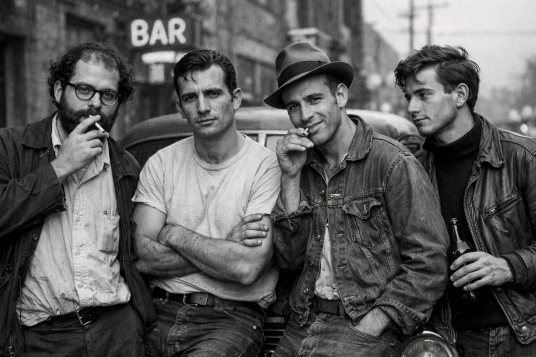
Yesterday I passed the 90-percent mark in On the Road, and I realized I was doing something I rarely do: willingly living a life I would never choose for myself. The novel offers the thrill of experience without the wreckage of consequence. It isn’t the kind of life I’ve ever aspired to, but inhabiting it through fiction is exhilarating. There’s something uniquely powerful about living vicariously through a voice as urgent and alive as Kerouac’s.
The book brought back flashes of my own youthful attempts at rebellion—small, controlled bursts of wildness. But On the Road is wildness without an off switch. It’s 24/7 motion. Thankfully, Kerouac—writing through his alter ego, Sal Paradise—allows moments of sobriety and reflection. And what a writer he was. His prose can swing from breathless, jazz-like improvisation to quiet, almost mystical introspection in a single page.
Sal’s restless energy is fueled by his friend Dean Moriarty—based on Neal Cassady—along with Carlo Marx, modeled after Allen Ginsberg. (Contrary to a common assumption, the name “Carlo Marx” is a playful invention, not a direct lift from political theory.) Together, they plunge headfirst into risk, excess, and a kind of ecstatic self-destruction. Their lives teeter on the edge—high-speed car rides across the country, nights that blur into mornings, an endless cycle of bars, jazz clubs, fleeting romances, and abandoned responsibilities.
The cross-country trips—from New York to San Francisco and Los Angeles, through Denver, Chicago, and the wide-open stretches of Texas—feel less like travel and more like a fever dream of American motion. You don’t just observe the journey; you feel crammed into the back seat, hurtling through darkness at 100 miles per hour while Dean barrels ahead, barely watching the road. It’s chaotic, reckless, and oddly hypnotic.
Although much of the novel is set in the late 1940s (the book was published in 1957), it feels startlingly immediate. The mania, the depressive crashes, the craving for constant stimulation, the near-fatal accidents, the obsession with “the next thing”—the next drink, the next lover, the next town—make the story feel contemporary. When the action subsides, Kerouac pivots inward. Sal wandering alone on a quiet street, questioning the meaning of it all, delivers some of the novel’s most powerful passages. As Kerouac famously wrote, “The only people for me are the mad ones, the ones who are mad to live…” That line alone captures the book’s electric pulse.
The novel helped define the Beat Generation, a movement that later influenced the 1960s counterculture. I used to think “Beat” simply meant exhausted—tired of conformity and postwar conservatism. Kerouac himself clarified that he meant “beatific,” suggesting a kind of battered spirituality, a search for transcendent meaning beneath the chaos. And at times, the book feels almost religious in its longing.
Could someone live this way today? Perhaps. America still has its drifters and wanderers. I’ve encountered people who echo Kerouac’s characters—in parks where I trained for races, in gas stations late at night, in small towns where stories hang heavy in the air. But the modern version often looks harsher. Today’s road can lead not just to freedom, but to addiction, untreated mental illness, or violence. The romanticism is harder to sustain when reality intrudes.
That said, I’ve also met people down on their luck who were decent, determined, and working to rebuild their lives. Many carry painful histories that would humble anyone. Kerouac’s characters, for all their recklessness, are not caricatures; they are seekers—sometimes foolish, sometimes destructive, but undeniably alive.
On the Road isn’t a blueprint for living. It’s a testament to yearning—to motion, to friendship, to the relentless search for meaning across the vast American landscape. I would never want to live that life outright. But through Kerouac’s words, I’m grateful to have ridden shotgun.
2026-02-24 13:43:37
bookreviews
Visions of St Lazarus Chapter 7
Reflection on Being Alone with a Purpose
Contemplation of an Ordinary Man
American Son by Brian Ascalon Roley
Linda Ty-Casper: Awaiting Trespass
Personal Thoughts while Sampling the poetry of Nick Carbo
Naomi: Reflection on Holy Week
Visions of St Lazarus : Expanded version of Lazarus Kafkaesque Paper
Ramon Santos Reflections While Recovering
The Mild Stroke of Ramon Santos
Popong 22: Meditation On Handling Temptations
Popong 21 - Friday Night Reflection
Popong 19/ Life is Learning and Exploring
Popong 18 / Avoiding Distraction
Popong 12 / Meditation on Computer Obsession
Sunday Thoughts and Book Review
A Night at the Luneta Grandstand
Understanding my unique Self on my way to Retirement
A Visit to Quiapo with El Fili2
THE DIARY OF ANTONIO PIGAFETTA
Brother, My Brother (Ben Santos)