Alex Maskara
Thoughts, Stories, Imagination of Filipino American Alex Maskara
Welcome
HOME
Four Students 6
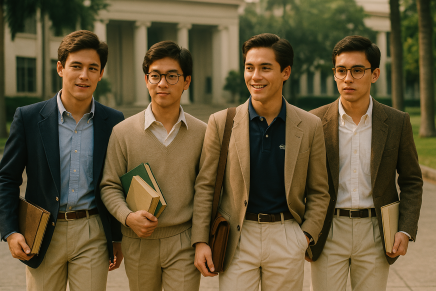
In Lerma, Sonny confronted Maliwalan student life for the first time—not as an idea, but as a condition. It was merely an extension of university existence, stripped of dignity. He sighed.
Students lived in cramped, makeshift rooms cobbled together from thin lawanit panels beneath blistering tin roofs. Inside, flattened cardboard served as walls. Along the pavements, lodgers scrubbed laundry beside communal faucets, rationing water drop by drop. Others hunched over scarred tables, poker cards spread, cigarettes hanging from their mouths. Billiard halls multiplied like weeds. Somewhere in a corner, a lone basketball court offered brief relief—a few minutes of sweat, movement, escape.
THE PHILOSOPHY OF LOLA SABEL
Sonny had been expected to study Medicine. His Americanized parents insisted—convinced that a son in the medical profession would one day reduce family hospital bills, assuming he made it to America.
The 1980s favored such thinking. They were the golden years of dollar remittances. The peso had collapsed, and any tie to Uncle Sam across the Pacific was salvation. The dollar meant power, prestige, survival. Sonny carried quiet status in his barrio because of the monthly envelopes from Illinois—George Washington’s face staring back at a country desperate for him.
In those days, wealth did not require millions. American shoes, Japanese gadgets, German labels—that was enough. Anything foreign was superior. Local goods were dismissed as *baduy*, *bakya*, cheap things for the poor. First Lady Mapang-Api cried for the masses in her Chanel suits, while activists in Nike sneakers denounced imperialism. Imported items—legal or not—were priced in dollars, always worth more, therefore better. Quality, people believed, came with a higher exchange rate.
The poor absorbed this logic. Slowly, they learned to see themselves as inferior.
Lola Sabel would not allow Sonny to inherit that shame.
One night, she spoke with restrained fury.
> “Sonny, this time is worse than the war. At least during the Japanese Occupation, we knew who the enemy was. Today, the enemy wears our face. Look at my sari-sari store—prices rising every week. Mothers dig through their pockets for a lost centavo and find nothing. Then they lift their heads and ask for *utang*.
>
> “Families who were comfortable in the sixties are starving now. Some of us who survived the war are dying slowly. We escaped the Japanese only to be destroyed by our own.”
A woman came often at midnight, knocking softly for rice. Her name was Elena. She wore a clean duster, her hair tightly bound, her cough dry and useless. Her body had thinned into angles and bone.
One night she pointed to her two-year-old daughter and said, “Lola Sabel, I see it in her eyes. One day she will save us.”
“How,” Lola Sabel asked gently, handing her the rice, “when you can barely feed her?”
“She could be like Sonia—Indang Monang’s daughter. A maid at twelve. An entertainer in Japan at sixteen. Now she sends dollars home.”
Hope lit Elena’s face. She whispered thanks and disappeared into the dark.
Elena was twenty-four. Her husband, Ramon, had been abducted months earlier. Once a guerrilla, later a government informant, he vanished after a funeral. Lola Sabel supported Elena quietly—careful, cautious, aware of how easily compassion could become a liability.
Every time she saw the young widow, her chest tightened.
One evening, she found Sonny beneath the acacia tree.
“I am eighty and still standing,” she said. “I want to live long enough to see this country recover. I will never leave Maliwalu like your parents. Our blood is in this soil.
“I watched Ramon and Elena grow up. Their grandparents were my playmates. We planted rice together. Doors stayed open. Nights were filled with laughter, zarzuelas, shared meals.
“Now every house is locked. We survived the Japanese because we were united. Today, we destroy ourselves.”
Sonny answered carefully. “Lola, Maliwalu has fifty-six million people now. Things can’t be the same.”
She turned sharply. “Population doesn’t create crime. Poverty does. Hunger does. Hopelessness does.”
“What’s the difference,” Sonny asked, “between poverty then and now?”
“Then, poverty was imposed by foreigners. Today, it is manufactured by one of our own. When a leader steals without shame, everyone learns to steal. His crime becomes permission.
“But there is hope. One act of courage awakens many. One sacrifice reminds people who they are. That is the Maliwalan heart—quiet, buried, waiting.”
“And me?” Sonny asked. “Where do I belong?”
“Educate yourself. Observe. Question. Criticize—but with intelligence. Remember Christ in the desert. The Devil spoke Scripture; Christ answered with Scripture.
“Go to Maliwalu. Watch the people. Learn how they think. And be careful—those who know they are wrong are the hardest to confront.”
THE OTHER LODGERS
Still carrying Lola Sabel’s words, Sonny opened the door of his boarding house and nearly collided with a naked man pulling on his trousers.
“Sorry,” Sonny muttered, looking away.
The man later introduced himself as Rene, a freshman in Economics.
“You must be my roommate,” Rene said, grinning.
He was too old for a freshman. His eyes were bloodshot—whether from cigarettes or something stronger, Sonny couldn’t tell. Books were stacked everywhere: psychology, economics, philosophy.
“Mind if I smoke?” Rene asked, already lighting a Marlboro.
“I don’t like the smell of smoke.”
Rene laughed. “Do you think I care?”
Sonny swallowed his irritation. This man would share his space for a year.
He remembered Lola Sabel’s verdict on the youth:
“They live in a permissive culture—un-Maliwalan. They have forgotten Asian restraint and European faith.”
Sonny wondered what kind of education awaited him now—and what kind of men.
2025-12-15 18:04:37
4students
Visions of St Lazarus Chapter 7
Reflection on Being Alone with a Purpose
Contemplation of an Ordinary Man
American Son by Brian Ascalon Roley
Linda Ty-Casper: Awaiting Trespass
Personal Thoughts while Sampling the poetry of Nick Carbo
Naomi: Reflection on Holy Week
Visions of St Lazarus : Expanded version of Lazarus Kafkaesque Paper
Ramon Santos Reflections While Recovering
The Mild Stroke of Ramon Santos
Popong 22: Meditation On Handling Temptations
Popong 21 - Friday Night Reflection
Popong 19/ Life is Learning and Exploring
Popong 18 / Avoiding Distraction
Popong 12 / Meditation on Computer Obsession
Sunday Thoughts and Book Review
A Night at the Luneta Grandstand
Understanding my unique Self on my way to Retirement
A Visit to Quiapo with El Fili2
THE DIARY OF ANTONIO PIGAFETTA
Brother, My Brother (Ben Santos)